
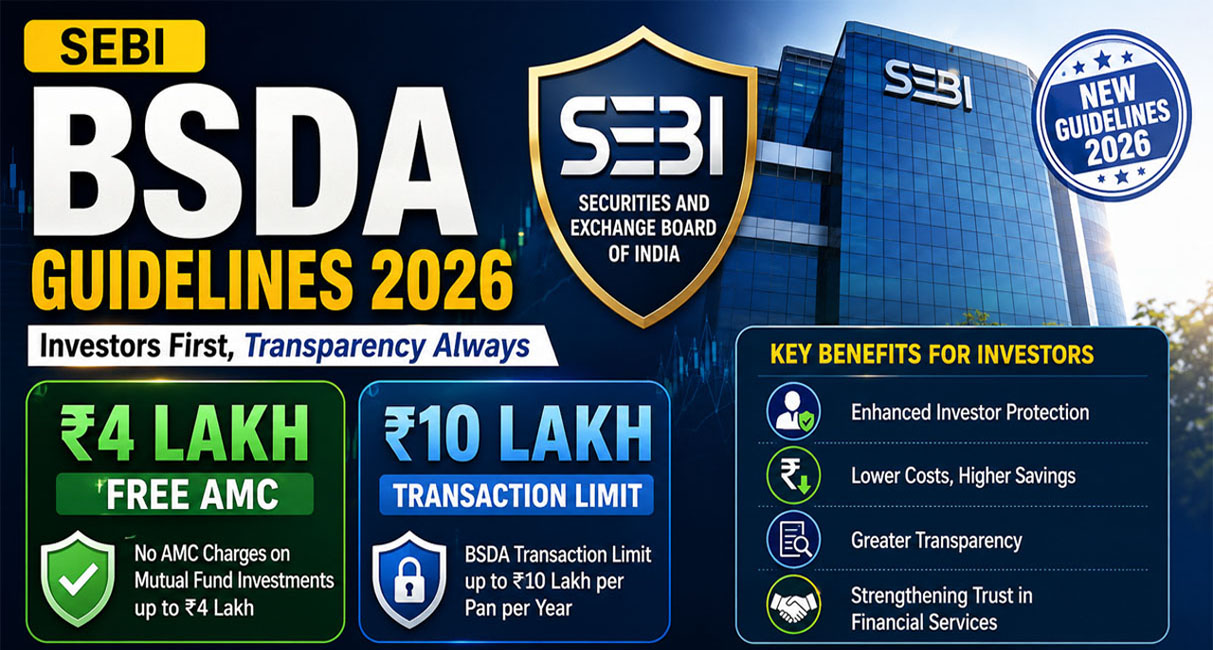
A Basic Services Demat Account (BSDA) is a low-cost demat account introduced by the Securities and Exchange Board of India (SEBI) in 2012. It is specifically designed to make investing more affordable for small retail investors by offering lower or zero annual maintenance charges (AMC) compared to a regular demat account.
Here’s a breakdown of its key features, based on the latest SEBI guidelines:
📋 Key Features and Eligibility
- Designed for Individuals: Only individuals can open a BSDA. Other entities like companies or HUFs (Hindu Undivided Families) are not eligible.
- Single Account Limit: You are permitted to hold only one BSDA across all Depository Participants (DPs) in India.
- Automatic Conversion: If the value of your holdings exceeds the ₹10 lakh limit, your account will be automatically reclassified as a regular demat account, which will then be subject to standard charges.
- Quarterly Reviews: Depository Participants (DPs) will review your account’s eligibility every quarter.
💰 Latest AMC Structure
The Annual Maintenance Charges (AMC) are the primary benefit of a BSDA and are determined by the total value of your holdings:
| Value of Holdings | Maximum Annual Maintenance Charges (AMC) |
|---|---|
| Up to ₹4,00,000 | ₹0 (Nil) |
| ₹4,00,001 to ₹10,00,000 | ₹100 + 18% GST (capped) |
| Above ₹10,00,000 | Account converts to a regular demat account |
✨ Key Recent Updates (Effective March 31, 2026)
SEBI has issued new rules to further enhance the BSDA framework, which will come into effect from March 31, 2026.
- Excluded Securities: The value of Zero Coupon Zero Principal (ZCZP) bonds and delisted securities will be excluded when calculating the total value of your holdings for BSDA eligibility. This means you can hold these securities without them potentially pushing your account over the ₹10 lakh limit.
- Default Account Type: Going forward, DPs will be required to automatically open or convert eligible demat accounts into a BSDA by default. If you wish to continue with a regular demat account instead, you will need to provide explicit, active consent through a verifiable channel.
This account type is ideal for first-time or occasional investors with smaller portfolios who want to keep their costs minimal.