
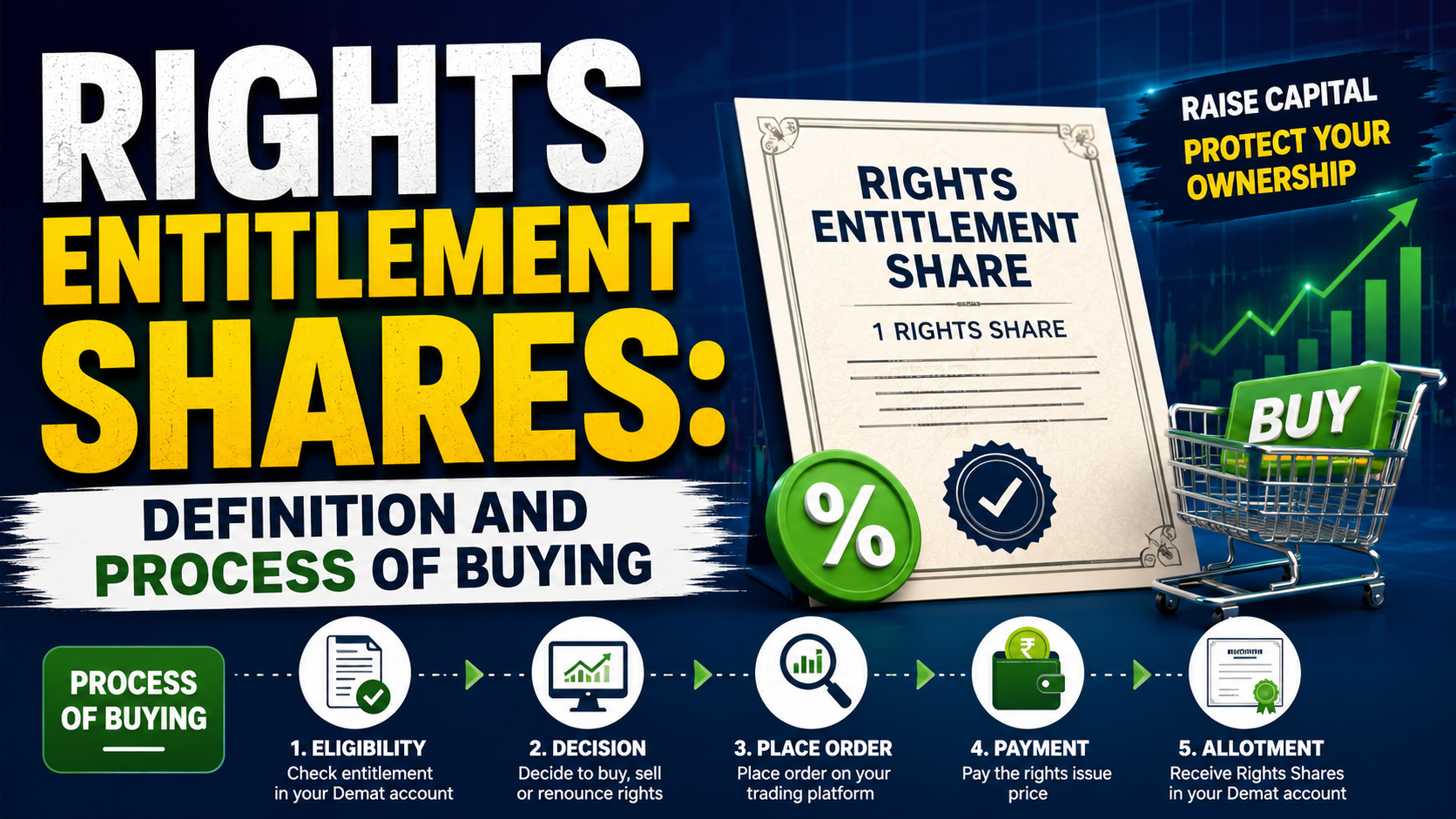
What are Rights Entitlement (RE) Shares?
Rights Entitlement (RE) shares are temporary dematerialized securities issued to existing shareholders of a company during a rights issue. They represent the shareholder’s eligibility to purchase additional shares at a discounted price, proportionate to their current holdings. REs are credited to the shareholder’s Demat account based on a predetermined ratio (e.g., 1:5 means 1 new share for every 5 held) and a record date set by the company.
Key features of RE shares:
- Temporary Credit: REs are valid only until the rights issue subscription period ends. If unused, they expire and become worthless.
- Tradable: Shareholders can sell their REs on stock exchanges (e.g., NSE/BSE) during a limited trading window.
- Discount Benefit: Rights issues are typically priced below the market value, allowing shareholders to increase their stake at a lower cost.
Process of Buying Rights Entitlement Shares
1. For Existing Shareholders
- Step 1: Eligibility Check
- Hold shares of the company before the ex-date (typically one day prior to the record date).
- Step 2: RE Credit
- REs are automatically credited to your Demat account based on your holdings as of the record date (e.g., 1:4 ratio for 100 shares = 25 REs).
- Step 3: Choose an Option
- Subscribe: Apply for rights shares via ASBA (Applications Supported by Blocked Amount) or the Registrar’s portal by paying the subscription price.
- Sell: Trade REs on the stock exchange during the designated window (settlement: T+1).
- Lapse: Take no action, and REs expire after the issue closes.
2. For New Investors (Non-Shareholders)
- Step 1: Buy REs from the Market
- Purchase REs through the stock exchange during the trading window (e.g., NSE Equity Segment). The base price is calculated as:
RE Price = Closing price of the stock − Rights Issue Offer Price.
- Purchase REs through the stock exchange during the trading window (e.g., NSE Equity Segment). The base price is calculated as:
- Step 2: Apply for Rights Shares
- Use the acquired REs to apply for discounted shares via ASBA or the Registrar’s portal before the deadline.
Key Considerations
- Timeline: RE trading typically closes 3–4 days before the rights issue ends to allow processing.
- Dilution Risk: New shares issued may dilute existing holdings, potentially lowering the stock price.
- Taxation: Selling REs incurs STT (Securities Transaction Tax) at 0.1% of the trade value (post-2024).
Example Workflow
- Company Announcement: ABC Ltd. announces a 1:5 rights issue at ₹90/share (market price: ₹120).
- RE Credit: A shareholder with 50 shares receives 10 REs in their Demat account.
- Decision:
- Subscribe: Pay ₹900 (10 shares × ₹90) to acquire discounted shares.
- Sell: Trade REs at ₹30 (market price: ₹120 − ₹90) for a profit.
Risks and Challenges
- Expiry: Unused REs lapse, leading to financial loss.
- Market Volatility: RE prices fluctuate based on demand and the stock’s performance.
- Payment Obligations: Partly paid shares (e.g., in tranches) require future payments; defaults render shares worthless.
For further details on ongoing rights issues or application procedures, refer to registrar websites or broker platforms.